
Blogs details
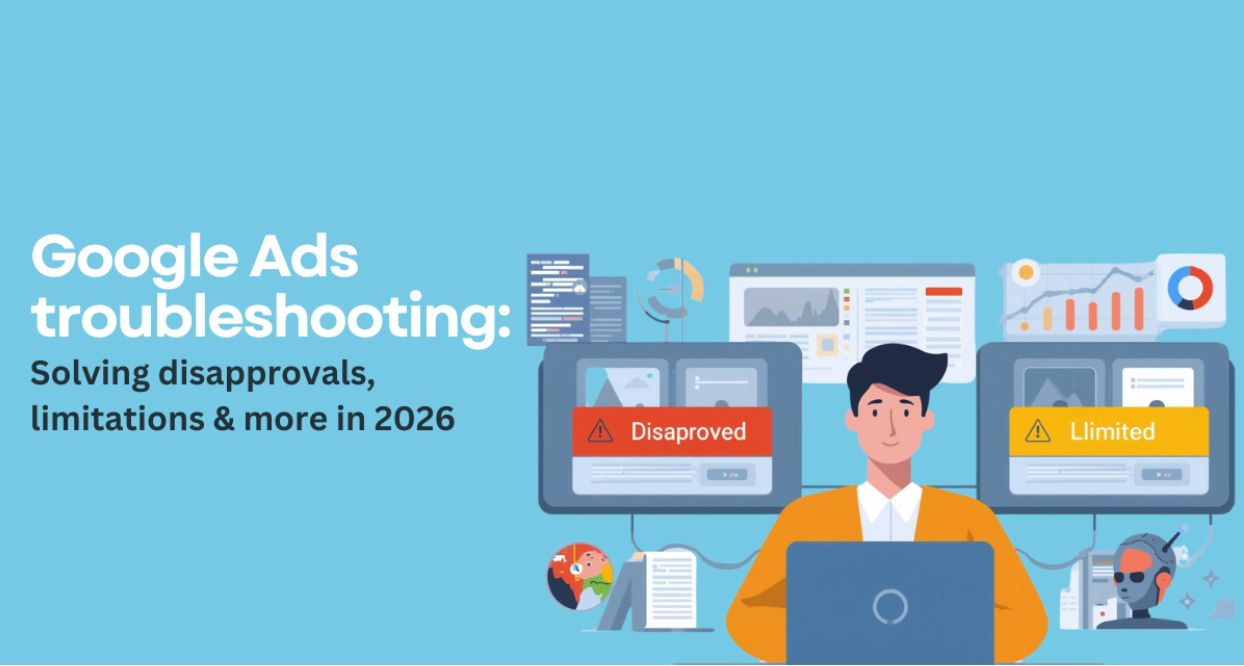
Google Ads troubleshooting: Solving disapprovals, limitations & more in 2026
Google Ads Troubleshooting 2026: Solving Disapprovals, Limitations, & Building Trust
Let's be honest: nothing kills your day like that dreaded email from Google Ads support. "Your ad has been disapproved." Or worse: "Your account is suspended."
In 2026, the game has shifted. It’s no longer just about bidding strategies and clever copy. It’s about trust, transparency, and technical hygiene. Relying heavily on Artificial Intelligence to patrol the site, Google's systems are now more intelligent, faster, and unforgiving than they have ever been.
Here's your humanized, realistic approach to avoiding the traps, correcting the unavoidable screw-ups, and maintaining your income engine operating smoothly: your 2026 plan.
Section 1: The Disapproval Dilemma – The AI Referee
Think of Google’s ad review system as a lightning-fast, slightly moody AI referee. It doesn't understand context or intent; it just checks your work against a massive list of rules. When you get a disapproval, don't panic. Just accept that the referee threw a yellow flag and you need to figure out why.
The Top 5 Disapproval Flags in 2026 and How to Talk Back
The most common mistakes aren't egregious policy violations; they're tiny technical slip-ups that the AI flags instantly.
1. Destination Experience (The "User Annoyance" Flag)
The Problem: Your ad is fine, but your landing page is a mess. Maybe it’s slow, full of pop-ups that block the content, or has a broken link. In 2026, site speed and mobile experience are non-negotiable compliance factors. Google sees a bad user experience as a violation of trust.
The Fix: Think like a picky customer. Check your page on a slow mobile connection. Make a required pre-launch inspection using Google's PageSpeed Insights. Should your site have pop-ups, be sure they are polite, non-intrusive, and not launched right away upon arrival.
2. Misleading Information (The Bait-and-Switch Flag)
The Problem: This is one of the quickest ways to earn an AI warning. You say "50% Off Everything" in the ad, but the landing page says "50% Off Select Items." Or, you claim to offer "guaranteed results" with no fine print. The ad copy and the landing page must be perfectly aligned.
The Fix: Be brutally honest. Remove any language that promises the impossible ("100% success rate") or uses excessive, unsupported superlatives. If your ad makes a specific offer, the offer must be immediately visible on the final URL.
3. Editorial & Grammar (The "Sloppiness" Flag)
The Problem: You’re stuffing your headlines with keywords, using excessive capitalization, or putting a string of exclamation marks to make your ad "pop" ("BEST!!! SALE!!! EVER!!!"). The AI views this as spammy, low-quality content.
The Fix: Write like a professional. Use customary capitalization. If you absolutely must use one, restrict yourself to one exclamation mark per advertisement. Never use the same word or phrase repeatedly throughout your Headlines and explanations: the artificial intelligence is meant to identify this repetitive keyword.
4. Unclear Business Identity (The "Who Are You?" Flag)
The issue is that Google wants users to be thoroughly aware of exactly who they are working with. The AI will limit or deny your advertisement if your landing page does not prominently feature your business name, a simple-to-find contact method, and your terms and conditions.
Guarantee your company name is plainly visible on the landing page and that Terms of Service and Privacy Policies are connected in the footer. If you are advertising in a banned category, like financial services, this openness is absolutely necessary.
5. Trademark Violation (The "Stolen Name" Flag)
Trademark Infringement: The Stolen Name Flag
The Issue: In your ad copy not in your keywords, which is usually permissible—you are employing a rival brand name in the actual wording the reader encounters.
The Fix: If you are not an approved distributor of the trademarked product, just take the name off your advertisement text. You have to give Google the appropriate authorization papers to show your right to use the name if you are licensed (for instance, as an automobile dealer).
The Golden Rule of Resubmission: Fix the Root Cause, Then Appeal
Don't just tinker with the ad copy. You have to first address the landing page if the disapproval pertains to it. Go to the Policy Manager in your Google Ads account once the page is clear, find the problem, and use the Appeal button. Frequently faster than waiting for the AI to re-crawl your site is a manual appeal saying that you repaired the page.
Section 2: Account Limitations & The Suspended Sentence
Ad disapprovals are common colds; account limitations and suspensions are the flu. They shut down your entire operation.
Understanding "Eligible (Limited)"
This status is often misunderstood. It doesn't mean your ad is wrong; it means the AI knows your product is restricted and will only show it under specific conditions (age, location, etc.).
The Human Angle: This is Google acting as a responsible regulator. You can sell alcohol, but not to minors, and not in countries where it's illegal to advertise.
The Fix: This almost always requires verification and geographic alignment. Check if you need to submit a certification form (common for healthcare, gambling, or political ads). Then, ensure your campaign geotargeting strictly adheres to the legal requirements of those verified countries.
The Catastrophe: Account Suspension
Account suspension is a serious matter, usually reserved for repeated or severe breaches. Never create a new account to bypass a suspension—that’s a direct violation of the Circumventing Systems policy, and it will only compound your problems.
1. The "Circumventing Systems" Violation (The Ultimate Red Flag)
This is the nuclear option. Google thinks you are actively trying to cheat their system.
Examples: Operating the identical unwelcome advertising; employing cloaking (showing the Google reviewer a policy-compliant page and the user a different, non-compliant page) across several accounts, or quick content changes to avoid discovery.
This demands the highest level of openness. You must submit a thorough, written appeal confessing the error (even if it was a coding error) and outlining the precise technical actions you took to correct the manipulation and expect bright future adherence.
2. The "Unacceptable Business Practices" (The Trust Breakdown)
This often comes after a mix of policy violations and poor customer reviews or regulatory complaints. Google decides your business practices are fundamentally untrustworthy.
The Fix: You need to show Google you are a real, honest business. Ensure your website has a working phone number, physical address (if applicable), clear refund/return policy, and that you are delivering what you advertise. The solution is often less technical and more about restoring your business credibility.
Section 3: Proactive Compliance in the AI Era (Future-Proofing for 2026)
The best troubleshooting is not needing to troubleshoot at all. Here’s the forward-thinking mindset for 2026.
1. Build Your Data Moat (Privacy First)
In 2026, First-Party Data (data you collect directly from your customers with consent) is gold. With the erosion of third-party cookies, Google is heavily favoring advertisers who use their own compliant data.
Action: Master Customer Match. Regularly upload your CRM data to Google Ads. Ensure your website's Privacy Policy clearly and accurately states how you collect and use customer data for advertising purposes. Non-compliant data usage is a fast track to limitation.
2. Feed the AI, But Don't Blindfold It
Google’s Performance Max and Responsive Search Ads (RSAs) are powered by AI. Your job is to give the AI the best inputs, not to over-control it.
Action: Max out your assets. Give RSAs all 15 headlines and all 4 descriptions. The AI is designed to test millions of combinations.
Selective Pinning: Only "pin" (force to a specific position) an asset if it’s legally required (like a brand name or disclaimer). If you pin too many assets, you handcuff the AI and your performance will suffer.
3. The "One Campaign, One Focus" Rule
Avoid creating huge, sprawling ad groups. The AI is built to optimize around clear themes.
Action: Maintain neatly themed Ad Groups with no more than 3–5 keywords per group, all very pertinent to one another. Knowing precisely which ad and landing page match the rejected keyword simplifies troubleshooting and boosts your Quality Score (which lowers your expenses).
Quick FAQs
Q1: I corrected my advertisement; however, the status remains at Under Review. What's the hold-up?
If it's over 3 business days, you may be in a queue for human review. Check the Policy Manager for the specific reason. If the reason involved your landing page, there might be a delay while Google re-crawls your site. The best move is to contact Google Support via chat, reference your Ad ID, and ask them to manually push the review.
Q2: What's the difference between a "Repetition" disapproval and "Keyword Stuffing"?
Repetition is a basic editorial mistake (e.g., using "Best Deals" in every single headline). Keyword Stuffing (which the AI is now very good at spotting) is an attempt to game the system by jamming your ad or landing page with the same keyword multiple times in an unnatural way to boost relevance. Both are fixed by writing more naturally.
Q3: My ad was suspended due to a "Malicious Software" flag. But my site is clean! Help!
This is terrifying, but common.
- Check Google Search Console (GSC) IMMEDIATELY. The ultimate resource for Google's security flags is GSC.
- Your usual security scanner might miss the malware, which is frequently buried in third-party scripts like a rogue tracking pixel or an outdated WordPress plugin.
Address the problem; next, ask for a site review via GSC; only after GSC is clear should you submit your appeal in Google Ads.
Q4: I’m using Performance Max (PMax) and my account got suspended. How do I fix a PMax asset?
Since PMax combines many assets, you have to be meticulous.
Check the Policy Details in the Policy Manager. The disapproval will usually point to the specific offending asset (image, video, or piece of text).
Go to the Assets tab within your PMax campaign.
Edit or remove the offending text or creative.
If the issue is on your landing page, fix the page and appeal the campaign after you’ve fixed the destination.
The shift in Google Ads is toward rewarding long-term trust over short-term tricks. If you commit to a compliant, user-friendly experience in 2026, the AI referee will be much kinder, and your campaigns will run with less friction and higher returns.
Q5: For a full-funnel strategy, how many Sitelinks should I utilize?
Google advises concentrating on quality rather than quantity, even if you can use up to 20 Sitelinks. For a full-funnel approach, aim for 6 to 8 highly Appropriate Sitelinks covering the whole trip:
- About Our Company: Awareness/Brand
- Compare plans, free guide, customer testimonials to help you understand value.
- Conversion/Action: Book a Demo, Shop Clearance, Get an Immediate Quote
Make sure every Sitelink leads to a distinct, quite pertinent landing page.